EU ETS and UK ETS Compliance
Carbon has become a cost of trading. Alongside fuel, port charges and insurance, a vessel’s emissions now bear on voyage economics, chartering decisions and, over time, its commercial viability. Three market-based measures give that cost its shape: the EU Emissions Trading System, the UK Emissions Trading Scheme and FuelEU Maritime. Together they mark a change in how emissions are regulated, and they reward operators who treat compliance as a continuous discipline rather than an annual submission.
Carbon compliance is managed across the year, not at the end of it. Every voyage plan carries an allowance exposure and every fuel decision affects it. A fleet monitored continuously can plan its allowance position and act where the rules allow, rather than meeting surprises at the surrender date. With allowance prices now at a level that makes carbon a material voyage cost, and the share of emissions covered by the EU ETS rising to 100 percent from the 2026 reporting year, the difference between managed and unmanaged compliance can be measured against the margin on a single voyage.
Synergy manages carbon compliance as part of a vessel’s daily operation, as the operating and technical manager integrating compliance into vessel operations. Synergy’s shore team works with each vessel to collect accurate emissions data on time and to reduce the discrepancies that create reporting risk. Where the commercial markets are involved, in allowance procurement and in sourcing compliance balance, Synergy works with Azolla. The aim is not simply to meet each deadline. It is to hold each vessel’s compliance position steady across the year and to keep open the commercial options a sound position protects.
EU ETS
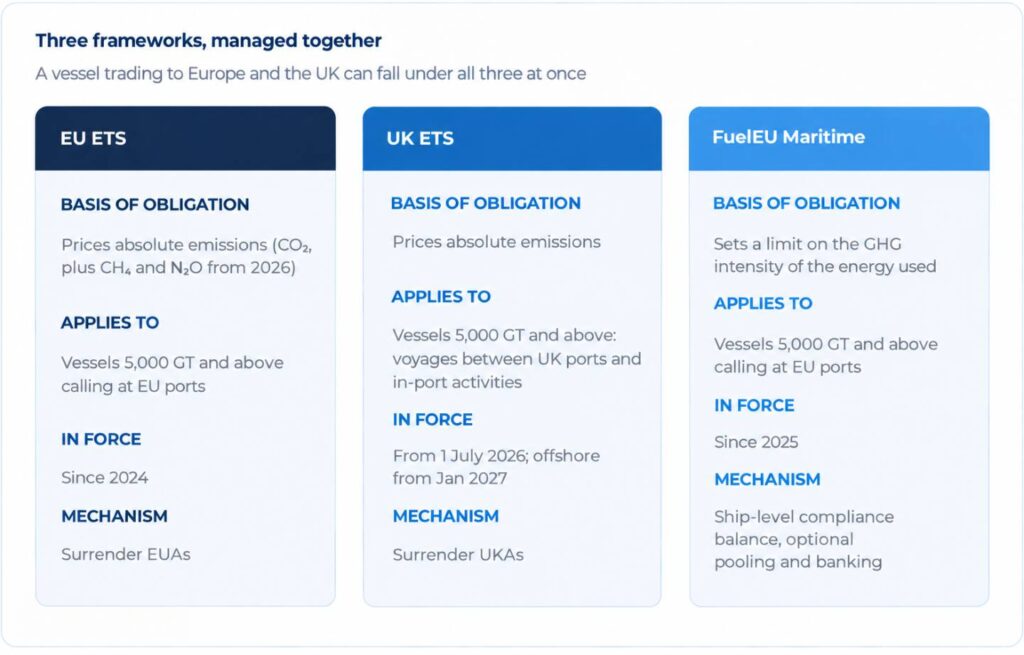
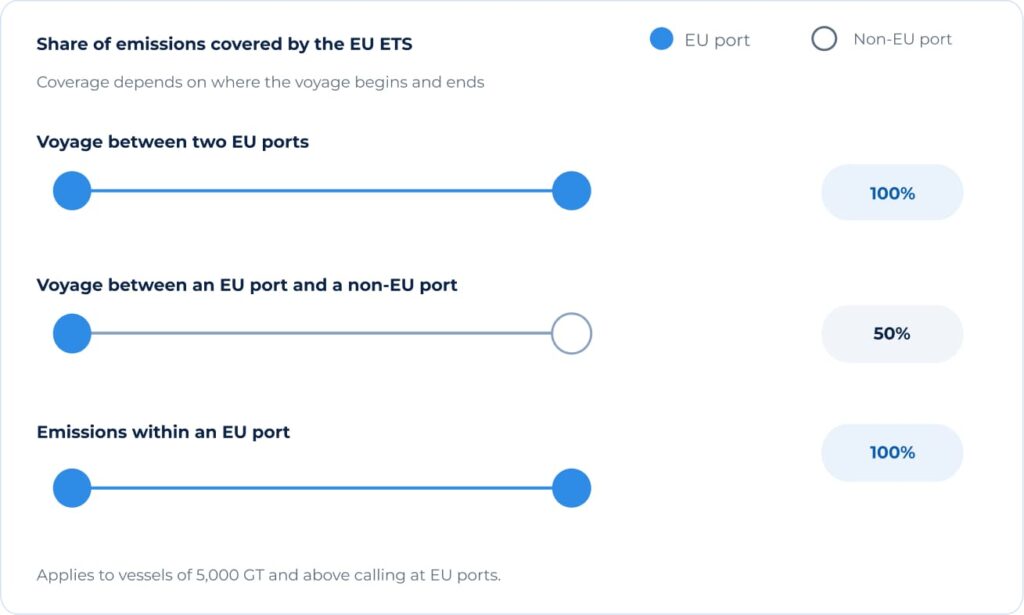
The EU Emissions Trading System has applied to vessels of 5,000 GT and above calling at EU ports since 1 January 2024. Its voyage coverage is defined: 100 percent of emissions on voyages between two EU ports, 50 percent on voyages between an EU port and a non-EU port, and 100 percent of emissions within an EU port.
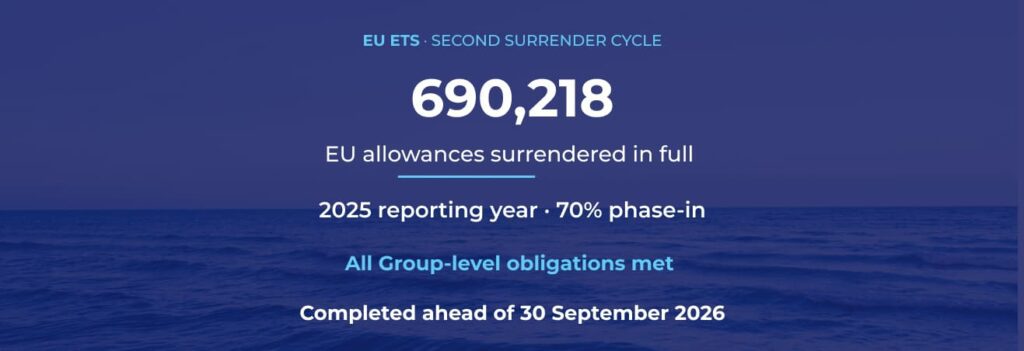
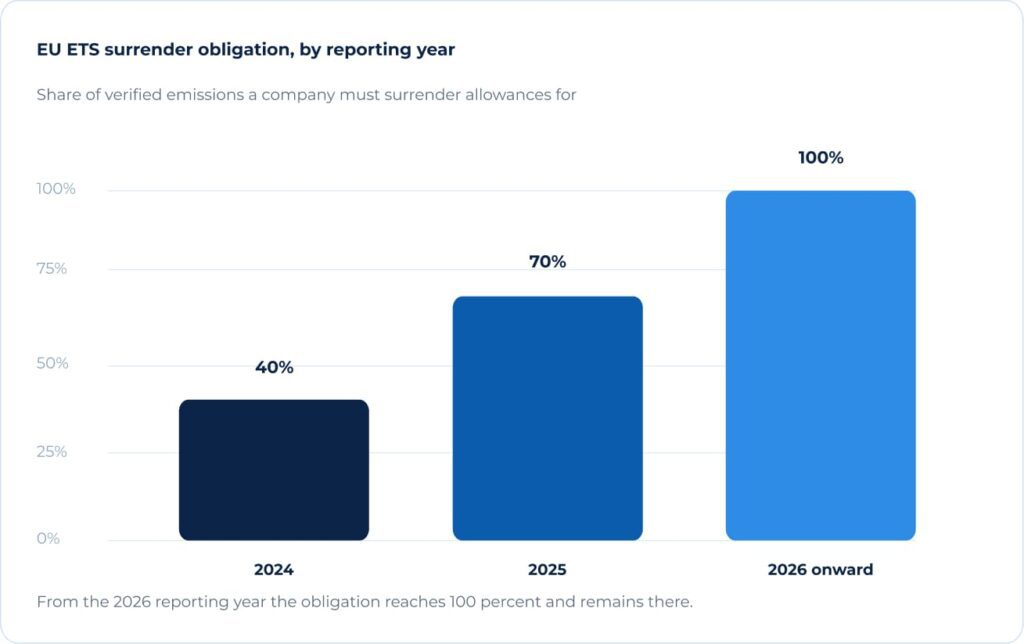
The surrender obligation is phased by reporting year. For the 2024 reporting year, companies surrendered allowances for 40 percent of verified emissions. For 2025, the obligation is 70 percent. From the 2026 reporting year onward it reaches 100 percent and stays there. Owners modelling their carbon cost several years out should plan against that trajectory rather than today’s partial obligation.
From the 2026 reporting year, the system extends beyond carbon dioxide to methane and nitrous oxide, measured on a CO2-equivalent basis. For LNG dual-fuel vessels this carries particular commercial weight. Where actual methane slip cannot be verified through certified measurement, default slip factors apply, and those defaults can overstate emissions and inflate the allowance obligation beyond what the vessel’s real performance warrants. The European Commission has issued guidance for measuring and verifying actual slip factors, and owners of LNG-fuelled vessels should assess whether moving from default to verified factors lowers their compliance cost.
2024 was the first year in which shipping operated under the EU’s carbon-pricing framework, and the first surrender cycle tested whether a manager could handle allowance compliance at scale. Synergy managed that first cycle across its directly managed fleet and for owners beyond it, spanning multiple ISM companies, a reach few managers could match. Synergy continues to manage EU ETS compliance for owners as the obligation rises to 100 percent from the 2026 reporting year.
UK ETS
The UK Emissions Trading Scheme extends to shipping from 1 July 2026, which marks the start of the first UK ETS scheme year for maritime. It applies to vessels of 5,000 GT and above, covering voyages between UK ports and in-port activities, with offshore vessels brought into scope from 1 January 2027. Operators must monitor, report and verify their emissions and surrender UK Allowances (UKAs), which are separate from EUAs. Allowances for the 2026 and 2027 scheme years are due together by 30 April 2028.
Synergy supports owners across the full UK ETS obligation: applicability assessment, preparation of the Emissions Monitoring Plan, data collection and validation, verifier coordination, emissions calculation, UK registry support, and UKA planning and surrender. For vessels trading to both the EU and the UK, the two schemes apply in parallel and on different bases, and Synergy manages them together so a single emissions data set serves both without duplicated effort.
How the schemes fit together
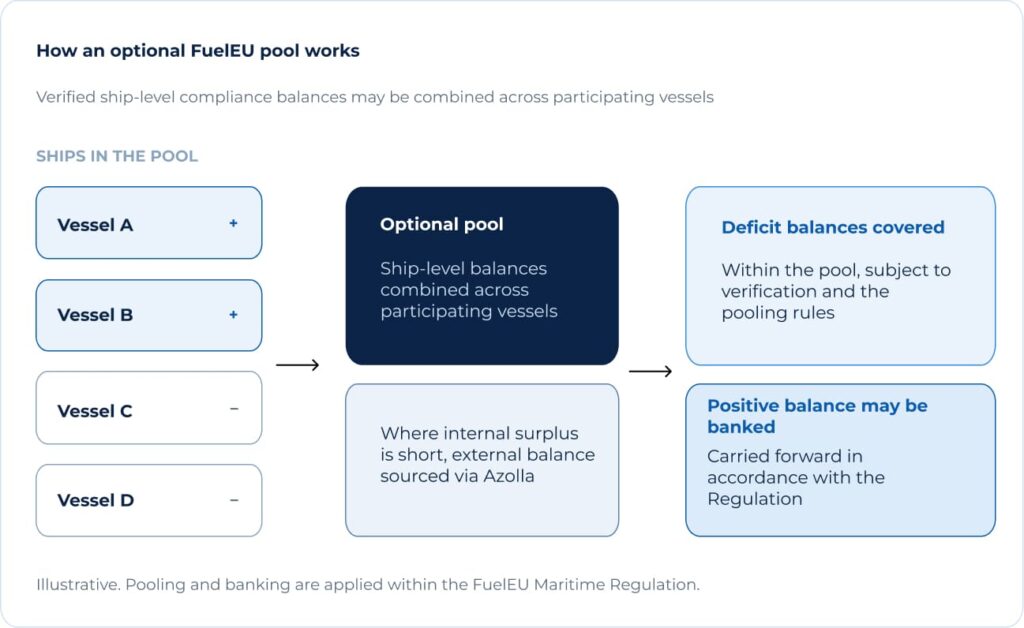
EU ETS and UK ETS are separate carbon-pricing regimes with separate allowances. FuelEU Maritime, which sets a limit on the greenhouse gas intensity of the energy a vessel uses rather than pricing its absolute emissions, runs alongside both. A vessel trading to Europe and the UK can fall under all three at once. Managing them in coordination, from one reliable data set, is what keeps both the administrative load and the cost under control.
Frequently Asked Questions
What counts as a port of call under the EU ETS?
A port of call is a stop where the vessel loads or unloads cargo, or embarks or disembarks passengers. A stop solely to take bunkers, to rest or to shelter is not a port of call. The distinction determines which voyages fall within scope.
What is the difference between CO2 and CO2-equivalent under the EU ETS?
For the 2024 and 2025 reporting years, only carbon dioxide is surrendered. From the 2026 reporting year, methane and nitrous oxide are included as well, expressed together with carbon dioxide on a CO2-equivalent basis.
Which vessels do the EU ETS and UK ETS apply to?
Both apply to vessels of 5,000 GT and above, subject to vessel type and the exemptions in each scheme. The EU ETS applies to vessels calling at EU ports. The UK ETS applies to voyages between UK ports and in-port activities, with offshore vessels included from 1 January 2027.
What is an EUA?
A European Union Allowance is the unit of compliance under the EU ETS. One EUA represents the right to emit one tonne of CO2-equivalent. A company that does not surrender enough allowances by the deadline faces an excess-emissions penalty and still has to surrender the allowances it is short.
How do the EU ETS, UK ETS and FuelEU relate?
They are separate frameworks that can apply at the same time. The two ETS regimes price emissions and require allowances. FuelEU sets a limit on the greenhouse gas intensity of the energy used and works through compliance balances, pooling and banking. For a vessel trading across all three, they are managed together rather than in isolation.