
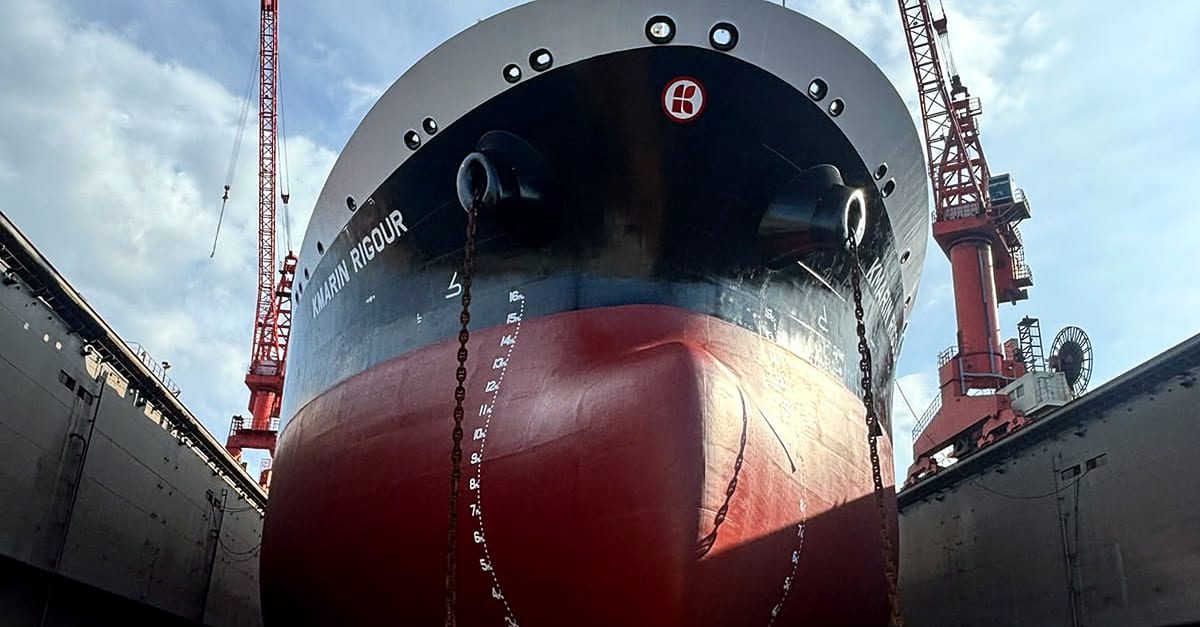
Nitin Kandwal, Senior DGM, Newbuilding and Conversions at Synergy Marine Group, explains how vessel and fleet history can reduce the work first identified only after docking begins.
The delay caused by a defect found in dock can cost more than the repair itself.
By Nitin Kandwal
On Day 4 of a dry docking, the work list meets the ship. Tanks are open, the underwater hull is being blasted and machinery is coming apart. A defect that would have been manageable at the planning stage can now sit on the critical path because the material was not reserved, the class review was not initiated, specialist labour was not booked or appropriate repair time was not built into the programme.
The precise condition may only become clear once the equipment is opened. What changes the outcome is whether the possibility, and its consequences, were considered before the docking clock started.
We recently worked through this using a hypothetical case: a 15-year-old VLCC on an 18-day docking period, examined as it stood on Day 4. Nothing in it is unusual, which is why it is useful.
A familiar Day 4
Blasting on the underwater hull is at 35 per cent against a planned 60. Weather stopped open blasting for six hours the previous day and some partially blasted panels flash-rusted overnight. A compressor was out of service for half a shift, and the yard had two blasting gangs working where the plan assumed three. One section of aft shell failed inspection and has to be blasted again.
The programme has limited recoverable float, so a two-day slip in the start of coating begins to threaten the redelivery date.

Two unexpected findings from opened-up equipment then enter the picture.
The scrubber overboard stub and its shell insert show significant wastage, with a leak at the stub-to-shell weld. A like-for-like renewal in carbon steel could recreate the same failure mechanism unless the design and protection system are addressed. A corrosion-resistant alloy and suitable protection system may be required, with the final selection determined by the scrubber design, operating conditions, class requirements and an engineering assessment.
In this scenario, neither the ship nor the yard holds the selected material. It must be ordered and certified, and the work requires an approved welding procedure and appropriately qualified welders. Because the surrounding area is already coated, the hot work also requires local surface preparation and recoating out of sequence, followed by the specified cure period before the dock can be flooded.
The main engine turbocharger nozzle ring, once opened, shows cracking across several vanes and eroded trailing edges. It is an OEM part with a long lead time and, in this scenario, is not carried on board. Reassembly, engine recommissioning and sea trials now wait on it.
Neither defect could have been diagnosed with certainty before opening. Both became critical because the materials, approvals and supply arrangements were addressed only after they were found.
How the cost builds
Once the vessel is opened up, the scope expands, but the yard’s manpower was planned against the original specification. Spares for new items must still clear customs, so the jobs that need them start late. The planned sequence breaks down as critical work waits for parts or specialist attendance. Additional labour may be brought in at short notice and the cost moves into the vessel’s budget.
The budget and the redelivery date can then begin to move together.
Where the specification should come from
A docking specification normally starts with class and statutory requirements, OEM guidance and the vessel’s job list. These define the known scope, but do not by themselves capture every condition risk that the ship may reveal once opened.
In our view, a sound specification draws on four sources.
Four sources of a specification
01
Mandatory scope
Statutory, class and OEM requirements
02
Vessel evidence
Inspection records, performance trends and maintenance history
03
Fleet evidence
Sister vessels and ships carrying the same equipment
04
Supply-chain consequence
Lead time, approval, specialist labour, customs and cure time
Mandatory scope is strengthened by vessel evidence, fleet evidence and the delivery consequence of likely findings.
The first is statutory, class and OEM requirements. The second is the vessel’s own inspection records, performance trends and maintenance history. The third is relevant evidence from sister vessels and ships carrying the same equipment. The fourth is the supply-chain consequence of each likely finding, including material lead time, class approval, specialist labour, customs clearance and coating cure time.
A large fleet offers a wider evidence base, provided its records are comparable and usable.
Comparable vessels can reveal recurring patterns, although no two operating histories are identical. Age, shaft running hours and wear-down records can indicate increased risk of stern tube liner grooving. Sister-vessel overhaul findings and running hours can show when piston crown inspection or spare positioning deserves attention. Mooring cycles, oil analysis and leak reports can indicate hydraulic winch deterioration. Anchor chain wastage can be assessed against age, anchoring history and previous gauging. If the chain and associated handling arrangements are unplanned, renewal can add weeks.
The turbocharger requires a more careful assessment. Exhaust temperatures, turbocharger speed against load, scavenge air pressure, main engine performance, fuel index and vibration trends may not diagnose a cracked nozzle ring. They can indicate elevated risk, and that may be enough to justify an inspection plan, early engagement with the OEM or the selection of a yard with suitable service support and stock nearby.
The objective is not to predict every defect. It is to reduce the proportion of the scope first discovered after the vessel enters dock.
Settling what can be settled
Not every item can be closed before arrival. Cargo tank steelwork, for example, cannot be fully assessed until the tanks are cleaned, gas-freed and staged. Items capable of holding a vessel for weeks, such as anchor chain renewal, boiler retubing, cargo tank structural repairs and rudder pintle and bush renewal, deserve the greatest attention before sailing. Gauging and surveys should be completed where practicable, material options identified, decision thresholds agreed and yard capacity discussed in advance.
Items such as cargo tank steam coils, wasted deck penetrations and large-bore engine-room pipework may be absorbed within the docking if the required materials and services are already available.
The practical aim is to close out as much uncertainty as practicable before arrival.
Settle before arrival / absorb in doc
Settle as far as practicable before arrival
Anchor chain renewal
Boiler retubing
Cargo tank structural repairs
Large-bore engine room pipework
Prepare so the work can be absorbed in dock
Cargo tank steam coils
Wasted deck penetrations
Rudder pintle and bush renewal
High-impact findings need early evidence, material decisions and yard capacity. Medium-impact work can be absorbed only when spares and support are ready.
Schedule pressure and safety
When a docking falls behind, recovery often increases the amount of work taking place in parallel. Schedule compression increases risk when that work expands faster than supervision and control.
A recovery plan should therefore include additional supervision, firm permit discipline and clear authority for anyone on site to stop work. A delayed programme never justifies a shortened safety step.
Telling the owner early
Any delay with cost or schedule implications should be assessed and reported to the owner as soon as it is understood, not at the end of the docking and never through a third party.
Variance reported early allows the owner to adjust chartering and budget plans while there is still room to do so. A late message can do more damage to trust than the delay itself.
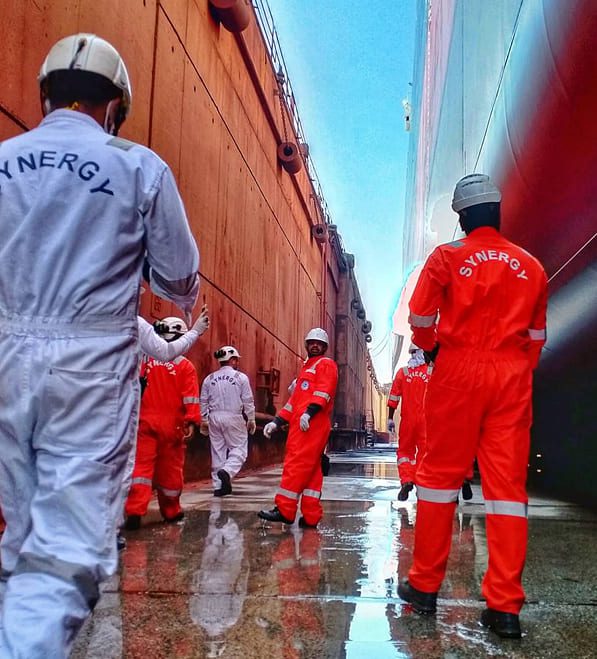
The best dry dock is the one nobody remembers afterwards. That is rarely a matter of luck. Much of it is shaped in the months before the vessel arrives.
Scenario note: The scenario in this article is a hypothetical composite prepared for training and awareness purposes. It does not describe a specific vessel.
ABOUT THE AUTHOR

Nitin Kandwal
Senior DGM, Newbuilding and Conversions, Synergy Marine Group.
Nitin Kandwal is Senior Deputy General Manager, Newbuilding and Conversions at Synergy Marine Group. A Class I marine engineer with two decades of experience, including 12 years at sea and service as Chief Engineer, he specialises in ship management, vessel dry-docking, ship repair, newbuilding and conversion projects. His experience covers yard selection, docking specifications, commercial negotiation, cost control, audits and vessel lifecycle project management. Nitin holds a Bachelor of Marine Engineering, an Executive MBA and a Postgraduate Diploma in Artificial Intelligence from IIT Delhi