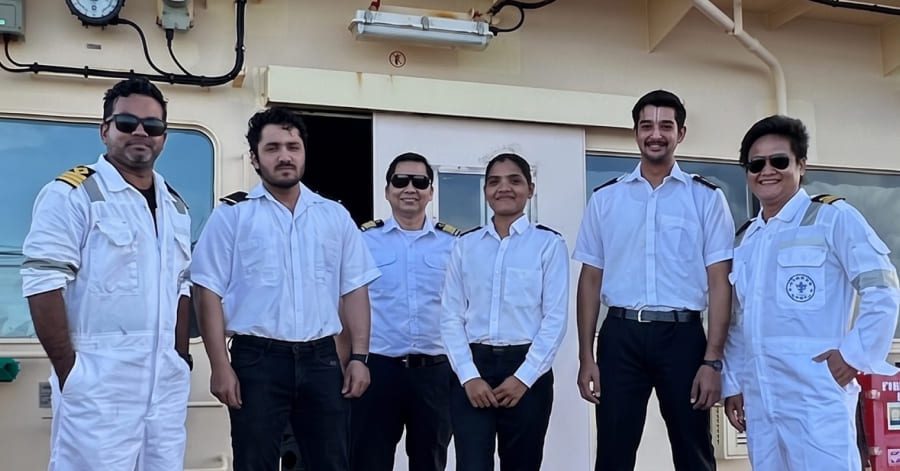
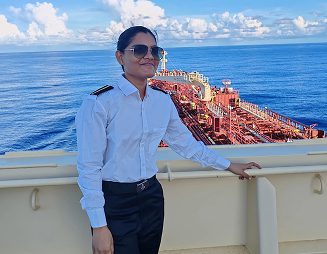
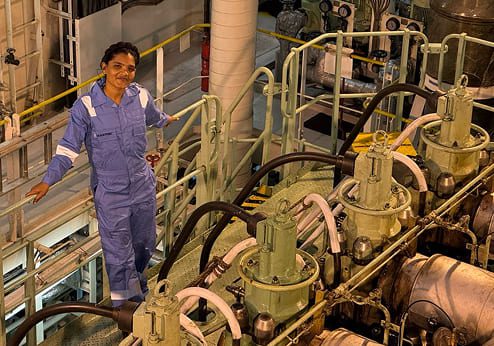
Jaishni is at the beginning of her seagoing career as an engine cadet. Raised along the coast of Tamil Nadu, her connection to the sea was shaped early, watching her father leave each day to work as a fisherman. What started as familiarity has taken a different direction, into a professional path built on engineering, discipline and exposure to life at sea. On board, her role is defined by learning, understanding systems, supporting maintenance and observing how decisions are made in real time. It is a stage where experience is built steadily, through routine, responsibility and attention to detail. Her journey reflects a transition from growing up around the sea to working within it, developing the foundations of a career in marine engineering.
1. What inspired you to choose a maritime career, and how has your journey evolved since your first days in pre-sea training?
I come from Tamil Nadu, where the sea has always been part of my life. My father is a fisherman, and growing up, I saw firsthand the courage and discipline required to work in such an unpredictable environment. That stayed with me. I wanted to take that connection further, but in a more structured and technical way. Choosing a professional maritime path allowed me to combine my interest in the sea with engineering knowledge and global exposure. Pre-sea training was a turning point. The discipline, safety focus and technical depth were very different from what I had imagined. Over time, what began as curiosity became a clear career path, supported by growing confidence in my abilities.
2. What have been the most meaningful skills or habits you have developed at sea that shape how you work today?
Working in the engine department has made me more disciplined and detail oriented. Even small errors can have serious consequences, so I have learned to follow procedures carefully and always prioritise safety. I have also developed practical problem-solving skills. Being exposed to real-time machinery operations and maintenance has helped me understand how systems behave beyond textbooks. At the same time, I have learned to stay composed under pressure and adapt to different situations. Each day brings something new, and that continuous learning shapes how I approach my work.
3. How would you describe your experience sailing with Synergy in terms of safety culture, teamwork and support on board?
Safety on board is taken seriously and forms part of everyday work. Regular drills, toolbox meetings and risk assessments ensure that everyone stays alert and prepared. There is also a strong sense of teamwork. The officers and crew support each other, and that makes a difference, especially in demanding situations. I have found the environment to be professional and respectful, with a clear focus on enabling people to perform at their best.
4. Could you walk us through a typical day on board and the aspects of your role that require the most focus and judgment?
Safety on board is taken seriously and forms part of everyday work. Regular drills, toolbox meetings and risk assessments ensure that everyone stays alert and prepared. There is also a strong sense of teamwork. The officers and crew support each other, and that makes a difference, especially in demanding situations. I have found the environment to be professional and respectful, with a clear focus on enabling people to perform at their best.
5. Has there been a moment at sea that left a lasting impact on you, either personally or professionally?
So far, there has not been a single defining moment. Instead, it has been a series of small, consistent experiences that have shaped my understanding of the role and the responsibility it carries.
6. How do you see technology and digitalisation influencing shipboard roles, decision-making and future career pathways?
Technology is already changing how we work. Advanced monitoring systems make it easier to track machinery performance and respond more quickly. At the same time, it means we need to build new skills, particularly around data, systems and digital tools. This will be important not just for current roles, but also for future opportunities ashore and at sea.
7. What qualities do you believe are essential for mariners today, and how do you consciously cultivate these in yourself?
Resilience, adaptability, teamwork and a willingness to learn are essential. I try to develop these by setting personal goals, learning from senior officers, and staying open to new experiences. Maintaining both physical and mental fitness also helps in managing the demands of life at sea.
8. What gives you the greatest sense of fulfilment or purpose at sea, and how does that compare with time spent ashore?
At sea, there is a strong sense of responsibility and purpose. You are part of a team where your work directly contributes to operations. There is also a unique connection with the environment and with colleagues, which creates a different kind of satisfaction. Time ashore offers a different balance, but at sea, the sense of contribution feels more immediate.
9. In what ways have you seen the maritime workplace become more inclusive, and what further progress would you like to see?
There is visible progress in terms of diversity and representation, along with clearer policies around safety and conduct. At the same time, consistency in implementation is important. Continued focus on fair treatment, safe working environments and accessible entry pathways will strengthen the industry further.
10. What would you say to young people considering a maritime career?
It is a demanding path, but also a rewarding one. If you are willing to learn, adapt and stay committed, it offers strong professional growth, global exposure and long-term stability. It is worth exploring with an open mind.