FuelEU Maritime Compliance
FuelEU Maritime sets a limit on the greenhouse gas intensity of the energy a vessel uses, and tightens it over time. Unlike a scheme that prices absolute emissions, FuelEU measures how clean the energy mix is, and it works through a compliance balance calculated for each ship, which can sit in surplus or deficit. The balance is settled once a year, but it builds through the year from the fuel a ship uses on each voyage. By the deadline, most of it is already set.
A vessel that uses compliant biofuel lowers its greenhouse gas intensity and improves its compliance balance. Depending on the quality and sustainability of the fuel, that can offset an initial deficit and, in some cases, generate a surplus. The value in FuelEU lies in what a manager does with those ship-level balances once they are known.
FUELEU MARITIME · FIRST COMPLIANCE CYCLE
First FuelEU cycle closed
Balances settled and surpluses banked. 2025 reporting period, across managed vessels calling at EU ports
A ship-level compliance balance
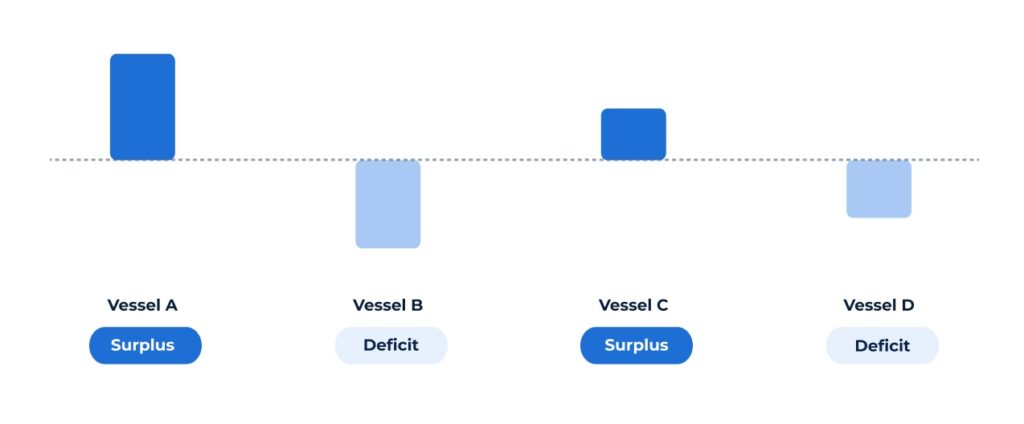
Each vessel ends up in surplus or deficit, depending on fuel choices made across the period
Pooling and banking
FuelEU compliance is calculated ship by ship. Pooling is an optional mechanism that combines the verified compliance balances of participating vessels, which may include ships from different companies. Where one vessel runs a deficit and another holds a surplus, the surplus can be applied within a pool to cover the deficit rather than left unused. Any remaining positive balance may be banked for future compliance years in accordance with the Regulation, rather than lost.
Azolla, part of Synergy Marine Group, supports the commercial execution of FuelEU Maritime compliance by helping identify and secure suitable external compliance balances and coordinating pooling arrangements with relevant counterparties. The approach is tailored to the vessel’s compliance position and the applicable regulatory requirements, with a focus on commercially viable outcomes, transparent coordination and effective execution. This enables shipowners and managers to evaluate available compliance options and manage their FuelEU Maritime obligations through a coordinated process.
How an optional FuelEU pool works
Verified ship-level compliance balances may be combined across participating vessels
SHIPS IN THE POOL
Vessel A
Vessel B
Vessel C
Vessel D
Optional pool
Ship-level balances combined across participating vessels
Where internal surplus is short, external balance sourced with Azolla’s facilitation
Deficit balances covered
Within the pool, subject to verification and the pooling rules
Positive balance may be banked
Carried forward in accordance
with the Regulation
Illustrative. Pooling and banking are applied within the FuelEU Maritime Regulation.
The first compliance cycle
2025 was the first FuelEU reporting period. Across roughly 223 managed vessels that called at EU ports that year, none incurred a FuelEU penalty. Ship-level balances were combined through pooling to cover deficits, including surplus sourced with Azolla’s facilitation, and around 1,900 MT of positive balance was banked for future years. On a worst-case basis, in which every deficit vessel paid the full penalty with no mitigation, the exposure managed to nil approached 14.68 million euros.
The figures matter, but what stands behind them matters more: establishing each ship’s balance, combining them through pooling where it helps and settling positions before the deadline rather than treating the regulation as a reporting task. That same approach extends to EU ETS and UK ETS compliance across the managed fleet. That same approach extends to EU ETS and UK ETS compliance across the managed fleet.
The discipline behind the result
How a managed fleet approaches each cycle
01
Establish
Each ship’s balance, built voyage by voyage
02
Combine
Balances through pooling where it helps
03
Settle
Positions before the deadline; external balance if needed
04
Bank
Remaining positive balance for future years
Pooling or borrowing?
Pooling
HOW IT WORKS
Combines balances of participating ships to cover a deficit
CONSTRAINTS
Fewer constraints
BEST FOR
Managed fleets: the more flexible route
Borrowing
HOW IT WORKS
Draws an advance surplus from the following year
CAP
2% of required GHG intensity × annual energy use
REPAYMENT
Returned next year with a 10% addition
The right mechanism depends on the ship’s position and the surplus available.
Frequently Asked Questions
What is a FuelEU compliance penalty?
If a vessel ends the period with a compliance deficit that is not resolved through the mechanisms FuelEU allows, a penalty becomes payable. The deficit can instead be addressed through pooling and banking, within the rules.
Is pooling better than borrowing under FuelEU?
They suit different situations. Borrowing draws an advance surplus from the following year, but it is capped at 2 percent of the vessel’s required greenhouse gas intensity multiplied by its annual energy use, and the borrowed amount is returned the following year with a 10 percent addition. Pooling instead combines the balances of participating ships to cover a deficit, with fewer constraints. For a managed fleet, pooling is usually the more flexible route, though the right mechanism depends on the ship’s position and the surplus available.
Does FuelEU Maritime apply to all vessels?
No. It applies to commercial vessels of 5,000 GT and above calling at EU ports, subject to vessel type and the exemptions in the regulation.
How does biofuel affect the FuelEU compliance balance?
Compliant biofuel lowers a vessel’s greenhouse gas intensity, which improves its ship-level compliance balance. Depending on the fuel’s quality and sustainability, it can offset a deficit and, in some cases, produce a surplus that can then be pooled or banked.