
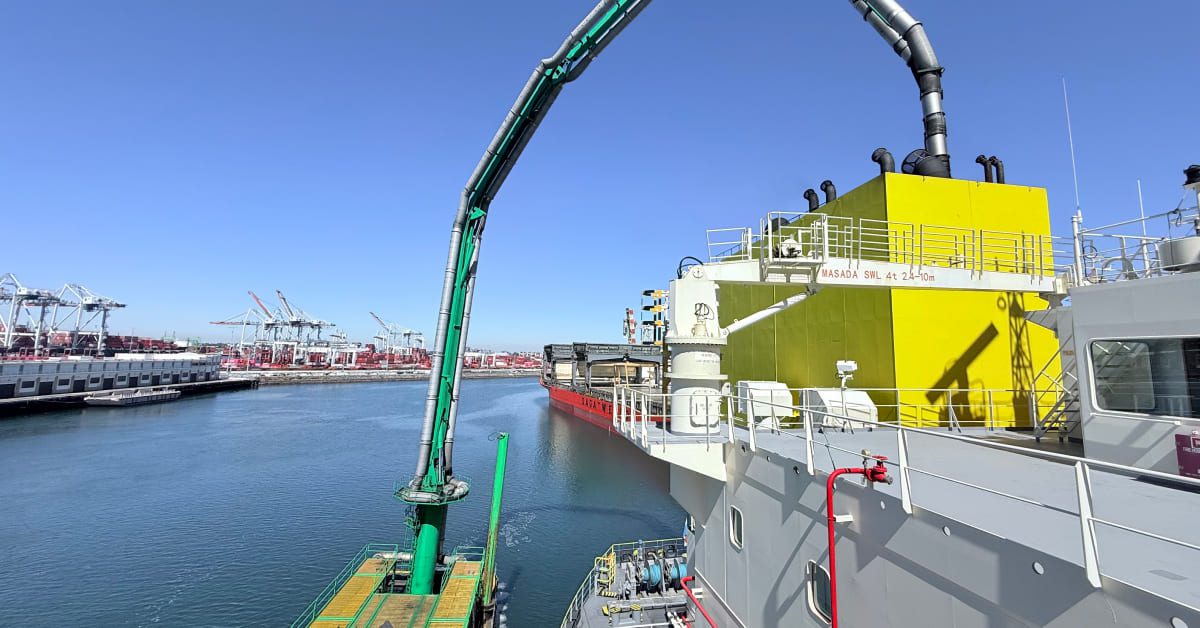
On 2 March 2026, “The Platinum Jubilee”, an MR tanker under the management of Synergy Pacific Private Limited (SPPL), completed berth operations at the Port of Los Angeles in compliance with the California Air Resources Board at-berth regulation (Title 17 CCR Section 93130), using STAX barge emissions capture technology as a compliant alternative to shore power.
What the regulation requires
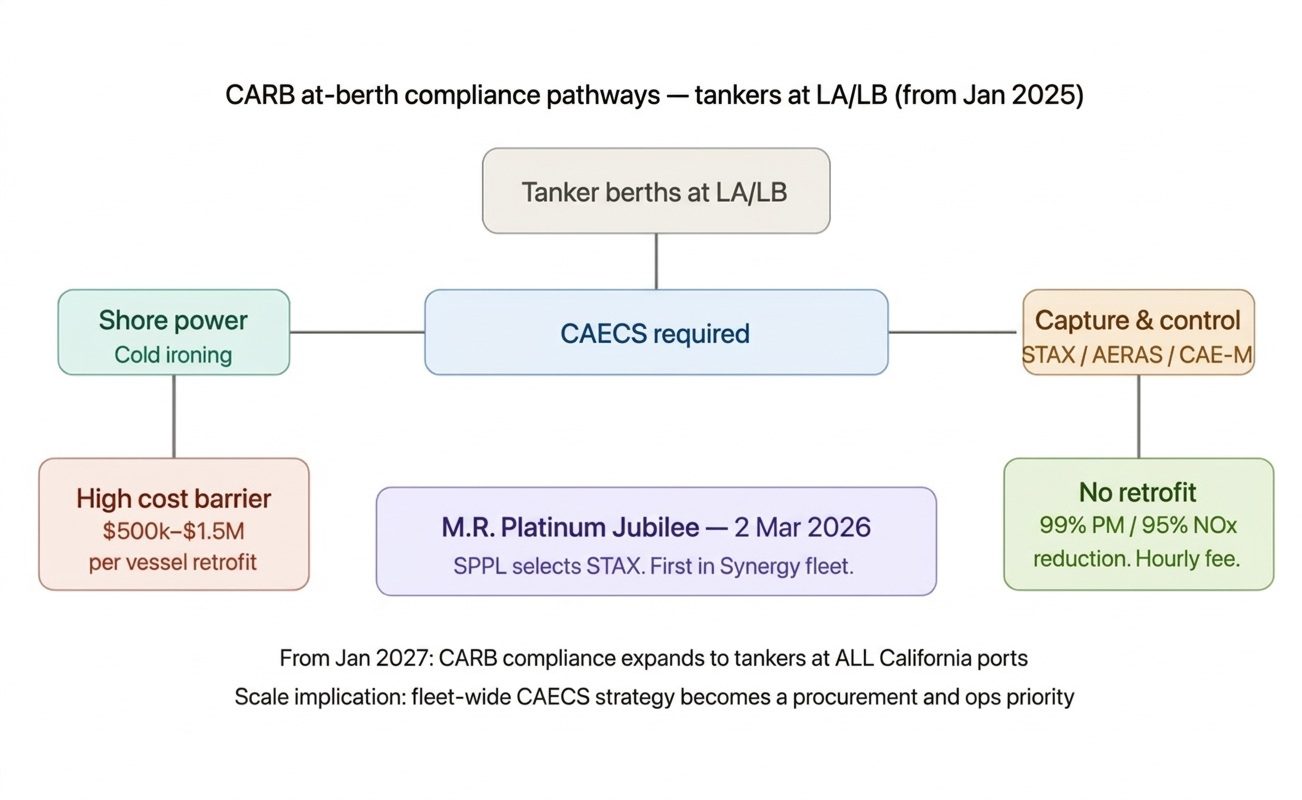
CARB’s at-berth regulation mandates that tankers at Los Angeles and Long Beach reduce auxiliary engine emissions during port stays. Shore power, which involves connecting a vessel to the port’s electrical grid, is the primary compliance pathway. Where shore power is unavailable or operationally impractical, CARB approves alternative Capture and Control systems. STAX is one such CARB-approved system. From January 2027, the regulation extends to tankers at all California ports.
How the STAX system works
The STAX barge is a mobile emissions capture unit that moors alongside the vessel at berth. An articulated arm connects to the ship’s exhaust outlets, routing gases to specialised filtration units aboard the barge. The process requires no onboard modification and no connection to shore-based electrical infrastructure. Independent measurements indicate reductions of up to 99% in particulate matter (PM) and up to 95% in nitrogen oxides (NOx) compared to uncontrolled auxiliary engine emissions.
Preparation and execution
For SPPL, the priority was safe integration alongside live cargo operations. A Non-Routine Risk Assessment was completed in advance, with STAX specialists and the vessel team jointly establishing connection and monitoring procedures before cargo work commenced. The operation proceeded without disruption to cargo handling or vessel schedule.
Under the leadership of Captain Vivek Mittal and Chief Engineer Ajay Fernando, and with active shore-side oversight from the SPPL technical and operations team as Document of Compliance holder, the operation was completed safely and without incident.
Relevance for fleet operators
As CARB’s at-berth requirements expand to all California ports from January 2027, operators managing tanker fleets on trans-Pacific and US West Coast trades will face increasing compliance touchpoints. Shore power availability varies significantly by terminal. Mobile emissions capture systems offer a scalable approach that avoids both the capital cost of permanent onboard modification and the operational dependency on port infrastructure.
Frequently Asked Questions
What is the CARB at-berth regulation and which vessels does it cover?
The California Air Resources Board at-berth regulation (Title 17 CCR Section 93130) requires commercial vessels, including tankers, container ships, and bulk carriers, to reduce auxiliary engine emissions while berthed at California ports. For tankers at Los Angeles and Long Beach, compliance has been required since January 2025. From January 2027, the requirement applies to tankers at all California commercial ports.
What is the STAX barge system and how does it reduce ship emissions?
STAX is a CARB-approved mobile emissions capture system. A barge moored alongside the vessel captures exhaust gases via an articulated connection arm, routing them to filtration units that process pollutants before release. Independent measurements show reductions of up to 99% in particulate matter and up to 95% in NOx compared to uncontrolled auxiliary engine emissions. No structural modification to the vessel is required.
Can ships comply with CARB without connecting to shore power?
Yes. CARB’s at-berth regulation permits compliance through approved alternative technologies, formally classified as Capture and Control systems. The STAX barge is one CARB-approved system in this category. Others include systems operated by AERAS Technologies and Clean Air Engineering-Maritime. These alternatives are particularly relevant where shore power infrastructure is unavailable or where the vessel’s electrical system is incompatible with the port supply.
Does the STAX barge require vessel modifications?
No structural retrofit is required. The system connects to the vessel’s exhaust via an articulated arm, making it compatible with existing fleets without drydock or capital expenditure.
What operational planning is needed for a STAX deployment?
Effective deployment requires advance coordination between the vessel team, the ship manager’s technical department, and STAX specialists. Key steps include a Non-Routine Risk Assessment, establishing connection and monitoring protocols, and confirming scheduling with the terminal to align barge positioning with the vessel’s berth window and cargo operations.
Is STAX a replacement for shore power?
It is a CARB-approved alternative where shore power is unavailable or impractical, not a replacement in all cases. Shore power remains the preferred pathway for vessels with compatible systems and where port infrastructure supports it. STAX and similar capture systems fill the compliance gap for the significant portion of berths where shore power cannot be practically used.